

CoSourcing in HR – Sustainable, Flexible, and Integrated
HR and payroll are no longer just support functions. In today’s organizations, expectations are rising rapidly: remote teams, international business models, increasing legal complexity, and the need for smart digital tools require HR solutions that are not only reactive but proactive, scalable, and sustainable.
In this context, four models are typically discussed:
- Outsourcing
- Temporary staffing
- Freelancers
- CoSourcing
This article provides an overview of these approaches, with a particular focus on CoSourcing. Using a real-life case study with financeAds International GmbH, we demonstrate how this model works in practice — as both a long-term partnership and a flexible interim solution.
Traditional Models: Strengths, Weaknesses & When to Use Them
Outsourcing: Efficient, but Often Distant
Outsourcing involves handing over defined tasks or entire processes to an external provider on a long-term basis. Many companies choose this model to improve efficiency or fill internal gaps. While it can offer specialist knowledge and process standardization, there are trade-offs:
Strengths:
- Access to external expertise, particularly in areas like compliance or international tax
- Streamlined processes with clearly defined responsibilities
- Reduces internal workload — ideal for teams without a dedicated HR function
Weaknesses:
- Less control over day-to-day operations and strategic alignment
- Vendors often apply their own standards, which may not reflect your culture
- Knowledge and insights may not flow back into your company — a "black box" effect
- Adapting the solution to specific needs can be time-consuming and costly
💡 In Germany alone, the HR outsourcing market is projected to reach €5.6 billion by 2025 (source: IbisWorld).

Temporary Staffing: Quick Help, Short-Term Impact
Temporary staffing (commonly known as “Arbeitnehmerüberlassung” in Germany) means bringing in an external employee on a limited-term basis — often to cover maternity leave or fill sudden gaps.
Advantages:
- Fast availability
- Smooth integration into internal processes
Drawbacks:
- Knowledge is often concentrated with a single person
- If they leave or become unavailable, operations can be disrupted
- Seldom leads to long-term process improvements or structural change
Freelancers: On-Demand Expertise, Limited Continuity
Freelancers are often brought in for special projects — for example, to implement new HR tools or advise on compliance.
Advantages:
- High flexibility and speed
- Niche expertise when and where it’s needed
Drawbacks:
- Usually no long-term commitment
- Continuity suffers if the freelancer leaves
- Limited knowledge transfer and documentation
- Compliance risk in some jurisdictions (e.g. "false self-employment")
CoSourcing: The Integrated Hybrid Model
CoSourcing combines the benefits of external expertise with the control and integration of in-house HR. It’s not just about outsourcing tasks — it’s about building HR together, continuously learning, and improving.
Key characteristics of a well-designed CoSourcing model:
- Team-based instead of single-person dependency: Built-in redundancy, shared knowledge
- Internal control remains intact: Strategy, culture, and decisions stay within your organization
- Collaborative processes: Workflows and documentation are jointly defined and continuously refined
- Flexible use cases: Works well as interim help or a permanent solution
- Scalable with your growth: No need to restructure as your team expands
- Structured knowledge transfer: Reduces key-person risk and improves long-term HR capability
"CoSourcing means more people, but not more cost."
– Outsource Accelerator
The result? Closer collaboration, higher trust, and a true partnership — rather than a distant service.
Case Study: Long-Term CoSourcing with financeAds
About financeAds
financeAds International GmbH is a Europe-wide provider of performance marketing solutions for banks, insurance companies, and FinTechs. The company currently employs around 20 people, most of whom work remotely, with a small office located in Berlin.
We’ve supported financeAds since the very beginning of KUNO — and, uniquely, our collaboration with their CEO began even before that, in 2016. There’s no internal HR department. Instead, we act as a fully embedded HR team, working hand in hand with the CEO and key team members.
What We Do for financeAds – Across the Employee Lifecycle
Contracts & Onboarding
When a new hire is planned, financeAds shares the key data with us. We draft the employment contract, apply relevant labor law standards, and handle any special cases (e.g. visas or international relocation). We also provide onboarding materials, schedule welcome meetings, and ensure a smooth integration of new employees.
HR Administration & Support
We manage the day-to-day HR operations using tools like Personio and offer support for all employee-related questions. From maternity leave to special leave requests, development paths, or benefits — we assist with it all. Even for complex legal cases (e.g. immigration), we coordinate closely with external law firms where needed.
Performance Reviews & Probation
We set reminders for regular feedback cycles and probation reviews, advising on adjustments, extensions, or role changes if necessary.
Payroll
Our internal payroll team manages the complete payroll process. This includes pre-payroll data gathering, cross-checking with HR records, and ensuring all legal and tax considerations are accounted for. After processing, we review everything with the HR team and notify both the leadership and employees about any changes. All payroll-related questions are handled directly by our team.
Offboarding
When someone leaves the company, we handle contract terminations, final documentation, and provide certificates or references as needed.
Communication & Working Model
Every two weeks, we meet with the CEO — or cancel if no topics are pending. Employees can contact us anytime via a central email address. Thanks to our team-based setup, there’s always a main point of contact and a backup — ensuring continuity and reliability.
Impact & Feedback
The cooperation with financeAds International GmbH is a prime example of how CoSourcing works without an internal HR department — and still delivers full professional support.
"Working with the KUNO team has been a game-changer for our HR operations. You get the benefit of a whole team of experts, not just a single point of contact. They are proactive in their communication, reliable in their processes, and always bring a solution-oriented mindset to the table – whether it's day-to-day topics or more complex challenges.”
- CEO, financeAds International GmbH
Cost-Benefit & Strategic Value
Deciding whether to build internal HR structures or to rely on a CoSourcing model often comes down to economic and strategic considerations. Maintaining an internal HR department usually comes with fixed costs: salaries for qualified personnel, recruiting expenses, system investments, software licenses, and regular upskilling. These ongoing expenditures can represent a significant burden—especially for smaller companies or during phases of rapid growth—and limit operational flexibility.
By contrast, a CoSourcing model allows for demand-driven collaboration that can be managed more efficiently. Accessing a well-established external team that coordinates regularly and takes on relevant tasks reduces the typical risks associated with relying on a single person—such as absences, knowledge silos, or delays.
Technology also plays a key role: many CoSourcing setups come bundled with modern HR and payroll tools. Automation, structured processes, and digital workflows lead to time savings, fewer errors, and clearer responsibilities. Particularly in complex areas such as payroll, social insurance, or legal special cases, an experienced team provides active protection against back payments, audits, or compliance issues.
For leadership teams, this means: less operational overhead, more strategic freedom—and a clearly plannable cost structure that adjusts to actual needs.
Comparing the Models at a Glance
Choosing the right support model depends heavily on the internal structure, the level of integration desired, and the long-term strategic goals. Here's a side-by-side comparison of the most common approaches:
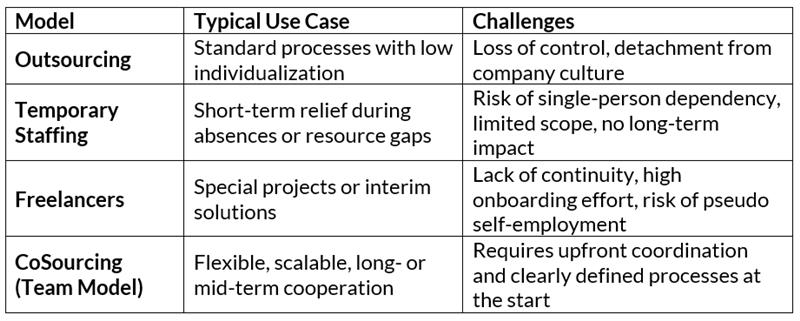
For companies in growth mode—or those that intentionally choose not to build an internal HR team—CoSourcing presents a highly adaptable solution. It scales with your needs while maintaining high quality, operational consistency, and a strong team structure.
Final Thoughts & What’s Next
CoSourcing isn’t a compromise — it’s a strategic HR solution for companies that value agility, reliability, and control.
Our collaboration with financeAds proves that even without an in-house HR team, it’s possible to maintain smooth processes, compliance, and employee satisfaction — when done with the right partner.
In future blog posts, we’ll explore other CoSourcing use cases:
- How does CoSourcing work alongside an existing HR team?
- How can it support global teams in different time zones?
- What about short-term or project-based collaboration (e.g. tool implementation)?
👉 Want to stay in the loop? Sign up for our newsletter — we share real-world insights, case studies, and practical tips.
👉 Contact us or book a meeting to find out more about CoSourcing.


.png)