
KUNO Now Part of the HR Collective Marketplace: HR Services for the HR Community in the DACH Region
News & Events
HR & People
KUNO Insights

KUNO Now Part of the HR Collective Marketplace: HR Services for the HR Community in the DACH Region

Author
Erica Ancobia
CEO & Managing Director
Date Published
May 19, 2026
Read time
4 min

KUNO Now Part of the HR Collective Marketplace: HR Services for the HR Community in the DACH Region

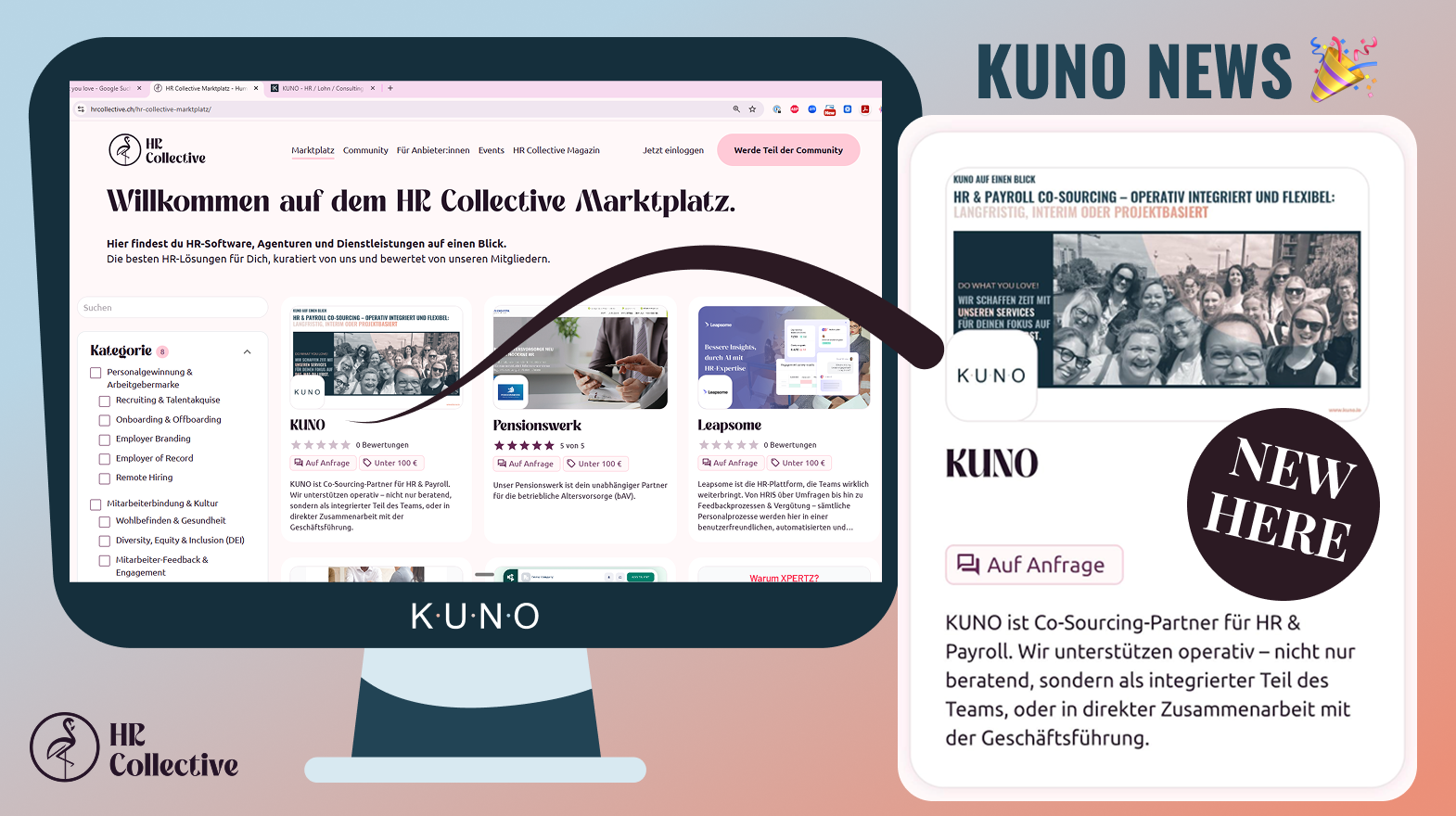
We are pleased to announce a new collaboration: KUNO is now part of the HR Collective Marketplace.

This means our HR and payroll services are now visible through one of the most exciting HR communities in the DACH region.

For us, this is another step in making our work accessible where HR professionals exchange ideas, learn from each other, and look for solutions for their daily work.  

What is HR Collective?

HR Collective is a growing HR community in the DACH region that connects professionals from HR, People & Culture, and recruiting.

The focus is on exchange, inspiration, and the shared goal of making HR more modern and impactful. The platform brings together HR professionals from different organizations – from HR generalists to CHROs – and creates a space for discussions about current people and workplace topics.

In addition to community formats, events, and knowledge content, HR Collective also provides a platform where HR tools, services, and providers are presented in a structured and accessible way.

The HR Collective Marketplace

The HR Collective Marketplace serves as a curated overview of HR solutions. Here, HR teams can search specifically for tools, services, or consulting offers that support them in their daily work.

The concept is intentionally community-driven.

Instead of presenting an overwhelming list of providers, solutions are curated and can be discovered and explored by the community.

For HR teams, this means:

  • faster orientation in a growing HR tools and services market
  • recommendations coming directly from an HR community
  • direct contact opportunities with providers

For providers, it creates visibility exactly where their target audience is active: among HR professionals who are actively searching for solutions.

Why KUNO Joined the Marketplace

At KUNO, we support companies in operational HR and payroll – from growing startups to established organizations.

Many HR teams face similar challenges:

  • increasing regulatory requirements
  • growing operational complexity
  • limited internal HR or payroll capacity
  • international company structures with local requirements

In situations like these, companies often look for pragmatic support – whether project-based, interim, or as a long-term extension of their HR setup.

The HR Collective Marketplace offers exactly the right framework for this.

HR professionals can discover providers there who help them navigate everyday HR challenges.

More Visibility for HR Services – Where HR Actually Works

For us, being part of the marketplace is more than a typical platform partnership.

It mainly means:

  • greater visibility within an active HR community
  • direct access to HR teams looking for solutions
  • exchange with other HR providers and experts

Because HR Collective strongly focuses on community and dialogue, it creates an environment that goes beyond traditional vendor platforms.

HR topics are not just consumed there – they are discussed, shared, and further developed together.

Do What You Love – Also in HR

At KUNO, our claim is “Do what you love.”

In practice, this means helping HR teams focus more on strategic topics – such as culture, leadership, talent development, and organizational growth.

Operational HR work and payroll are essential, but they can also be highly time-consuming.

Our approach is simple:

We support HR teams where they need operational relief so they can focus more on the topics that truly matter to them.

By joining the HR Collective Marketplace, we hope to make this approach accessible to an even broader HR community.

We are very happy to now be part of this network.

📌 Questions about HR communities? Contact us directly or book a meeting

📌 Follow KUNO on LinkedIn

📌 Subscribe to our newsletter so you don’t miss future insights

Did you find this article interesting?
Feel free to share it with others!

Discover More

Calculating vacation entitlement: Key rules and practical examples
HR & People
Payroll

Calculating vacation entitlement: Key rules and practical examples

Mandy Stegemann
Director Payroll Services
Published on
7.17.2026
X Mins Read

Vacation entitlement when regular working days change 

More and more employees change their working patterns during the course of the year. 

Typical examples include: 

  • moving from full-time to part-time work, or vice versa  
  • reducing the work week from five to four days  
  • increasing from three to five working days  
  • returning from parental leave  

In these situations, vacation entitlement should not simply be recalculated for the entire year. Instead, the entitlement should be assessed separately for each period. 

The purpose of this proportional approach is to ensure that employees are neither disadvantaged nor unfairly advantaged simply because the number of their regular working days changes during the year. Vacation entitlement should always reflect the employee's actual working pattern during each period. 

Example 

An employee works five days per week from January through June and four days per week from July through December. Employees working a five-day week receive 30 vacation days per year. 

In this case, a proportional calculation is appropriate: 

  • January to June: six months based on a five-day work week  
  • July to December: six months based on a four-day work week  

Vacation entitlement is calculated separately for each period using the applicable work schedule. 

These changes should always be documented carefully. It is equally important that HR, payroll, and managers all work from the same data to avoid inconsistencies between employment contracts, HR systems, payroll records, and vacation balances.

Why offsites are more than just a team event – and why shared time at work is often underestimated
KUNO Insights
News & Events

Why offsites are more than just a team event – and why shared time at work is often underestimated

Erica Ancobia
CEO & Managing Director
Published on
7.17.2026
X Mins Read

Offsites do not solve problems – but they can strengthen teams

Of course, a team event does not replace good leadership, healthy processes, or a functioning company culture.

Offsites do not solve structural conflicts, nor do they automatically turn every team into a “perfect match.”

Still, they can create something that often gets lost in everyday work: closeness. Not in a private sense, but in a human one.

Especially in work environments that are increasingly digital, fast-paced, and heavily scheduled, shared time outside of daily operations has become both important and valuable for many teams.

Not as artificial teambuilding or because everyone suddenly needs to become best friends. But because collaboration often works better when people do not only encounter each other between meetings, tickets, and deadlines.

Sometimes, that alone can already be enough to noticeably strengthen a team in the long term.


📌 Looking for inspiration fot your next team event? Contact us directly or book an appointment

📌 Follow KUNO on LinkedIn

📌 Sign up for our newsletters to not miss any further helpful tips

Co-sourcing in HR & payroll teams: when capacity is temporarily missing but quality must remain consistent
HR & People
KUNO Insights
Payroll

Co-sourcing in HR & payroll teams: when capacity is temporarily missing but quality must remain consistent

Erica Ancobia
CEO & Managing Director
Published on
7.17.2026
X Mins Read

Why co-sourcing matters for HR & payroll teams

For many HR teams, the main question is no longer whether external support is possible – but how to integrate it without creating loss of control or process disruption.

A team-based Co-Sourcing model provides:

  • operational stability during staffing gaps
  • retention of internal ownership and decision-making
  • protection against single-person dependency
  • predictable cost structures
  • flexible but structured operational support

Regardless of market conditions, qualified HR professionals remain key business-critical roles. Temporary reinforcement is therefore not a trend, but an established strategic approach to maintaining stability during transition periods without prematurely changing long-term structures.

LEARN MORE ABOUT KUNOKUNO