

BLOG

Workation: Working abroad – what companies and employees need to know
Do not underestimate data protection
Data protection and information security are also critical.
Employees working from a café, hotel, or coworking space face different risks than they would in a home office.
Companies should therefore establish clear requirements, such as:
- using a VPN,
- using encrypted devices,
- avoiding unsecured public Wi-Fi networks,
- using privacy screens when handling confidential data, and
- storing work devices securely.
This is particularly important for companies that handle sensitive employee, customer, or financial data.


.png)
%20(787%20x%20524%20px)%20(5).png)

CoSourcing for one-person HR: When a role wears many hats — and why support makes the difference
What Alternatives Exist – and Where Their Limits Are
Especially for managing directors and leadership teams, the question often arises of how a one-person HR role can be meaningfully supported and relieved.
A brief overview:
- Interns can help, but they are time-limited and require significant onboarding.
- Working students bring motivation, but are often only available short-term and focused on completing their studies.
- Freelancers can provide selective support, but are usually single-person solutions without built-in continuity or backup.
- Hiring a permanent additional role can be the right step, but is not always realistic – for example due to fluctuating demand or budget constraints.
CoSourcing offers an alternative: access to an entire team, with shared knowledge, built-in coverage, and flexible scaling – without long-term fixed costs.

Preparing for the German Pay Transparency Act: Why pay transparency becomes a strategic HR priority

Typical challenges in practice
In practice, three recurring challenges often emerge:
- Missing or inconsistent compensation frameworks
- Insufficient data quality in HR and payroll systems
- Uncertainty in internal communication
The communication aspect in particular is often underestimated. Greater transparency does not automatically lead to greater acceptance. Employees will ask questions, draw comparisons, and expect clear and understandable explanations. In this context, HR takes on the role of translator between numbers, systems, and lived perceptions of fairness.

Why the eNPS Is More Than Just a Number – or why we call it “Heartbeat” at KUNO
A Long-Term Cultural Indicator
Over the years, our Heartbeat has evolved in every direction – from negative scores during challenging times to moments of 100% positive feedback when the team felt especially stable and aligned.
These fluctuations aren’t a sign of instability – they’re a sign of honesty. They show that the eNPS is not a snapshot but a living indicator of team culture, trust, and cohesion.
A consistently high eNPS reflects strong collaboration and sustained satisfaction. A sudden drop, on the other hand, signals that attention or support may be needed – giving us the opportunity to act early. That’s the true strength of the eNPS: it makes cultural health visible and actionable.
How to Identify and Prevent "False Self-Employment" – Risks, Warning Signs, and Practical Guidance for Companies

The Status Determination Procedure (“Statusfeststellungsverfahren”)
In Germany, the Statusfeststellungsverfahren is an official administrative process conducted by the German Pension Insurance Authority (Deutsche Rentenversicherung) to determine whether an engagement qualifies as employment or self-employment.
Step-by-step overview:
- Application by either the client (company) or the contractor (freelancer).
- Review by the DRV based on documentation and the actual working relationship.
- Written decision issued by the authority.
- Option to file an appeal if there is disagreement.
Important: This is not a quick process. Depending on the case’s complexity and administrative workload, the procedure may take several weeks to several months. Companies should plan accordingly and avoid making long-term decisions until the results are available.
The process is particularly useful for long-term collaborations, new or critical roles, or when there is uncertainty about the working arrangement.

.png)
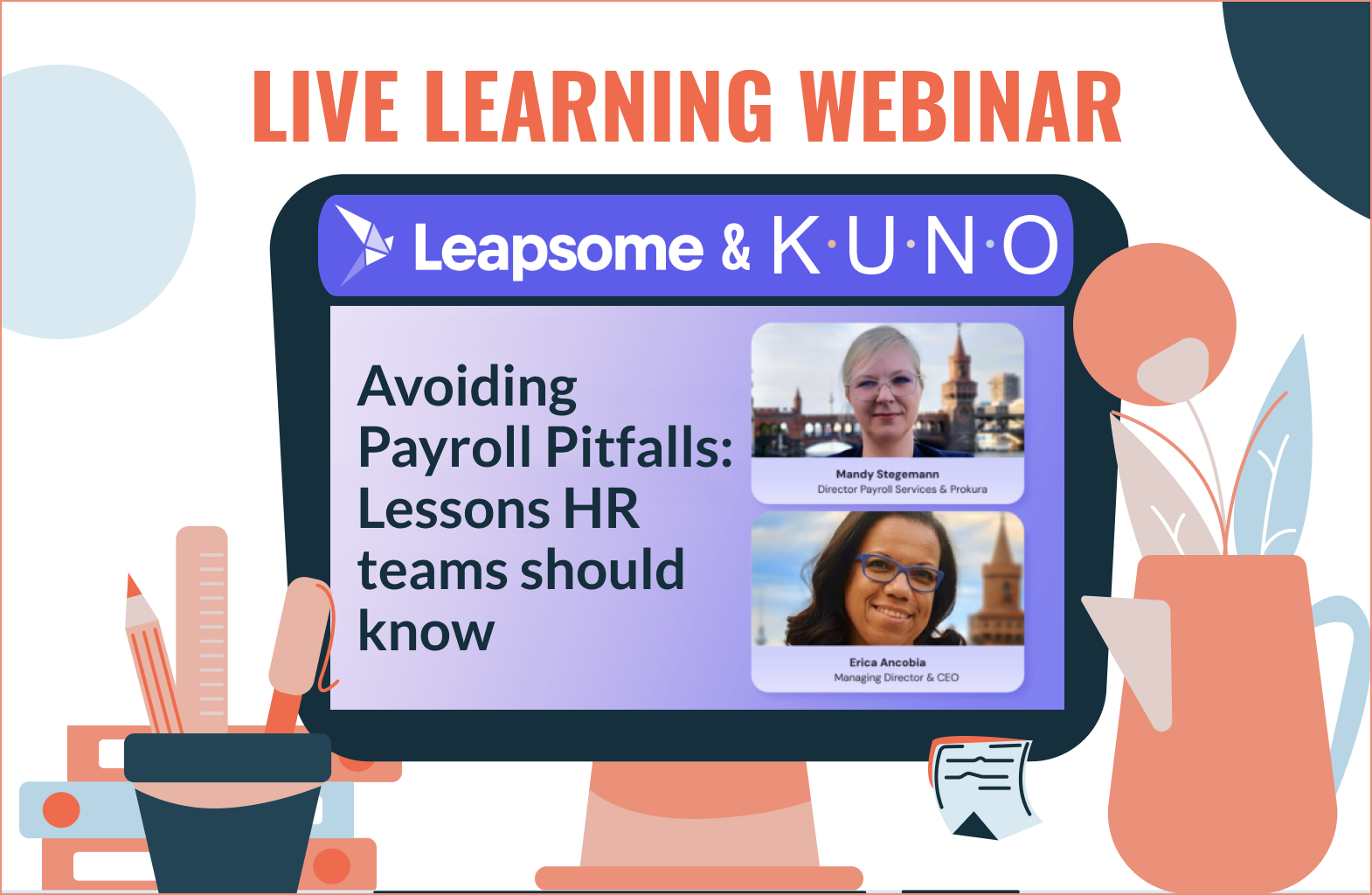
Avoiding payroll fails: stumbling blocks that HR teams should know
Digital Support: Leapsome as an HR Partner
The webinar also demonstrated how modern HR systems like Leapsome help simplify payroll. Centralized data, transparent absence tracking, and automated reports reduce manual work and prevent data gaps. Especially for growing teams, digital support is key to maintaining compliance.
👉 Learn more: www.leapsome.com

Women Talk Tech: From Career Change to Leadership

Personal Reflections & Learnings
In the podcast, Erica also shares personal stories — including how her family life and work life influence one another. A guiding principle for her has always been courage to try something new, even when uncertainty is present.
“What’s the worst thing that can happen to me?”
That mindset encourages her to take chances, reflect, and grow through experience. One of her favorite quotes captures this outlook perfectly:
“Experience is what you get when you didn’t get what you wanted.”
It’s a philosophy that defines her journey — staying open to new paths, embracing change, and viewing mistakes not as failures, but as valuable lessons.

CoSourcing in human resources — sustainable, flexible and integrated
Impact & Feedback
The cooperation with financeAds International GmbH is a prime example of how CoSourcing works without an internal HR department — and still delivers full professional support.
"Working with the KUNO team has been a game-changer for our HR operations. You get the benefit of a whole team of experts, not just a single point of contact. They are proactive in their communication, reliable in their processes, and always bring a solution-oriented mindset to the table – whether it's day-to-day topics or more complex challenges.”
- CEO, financeAds International GmbH
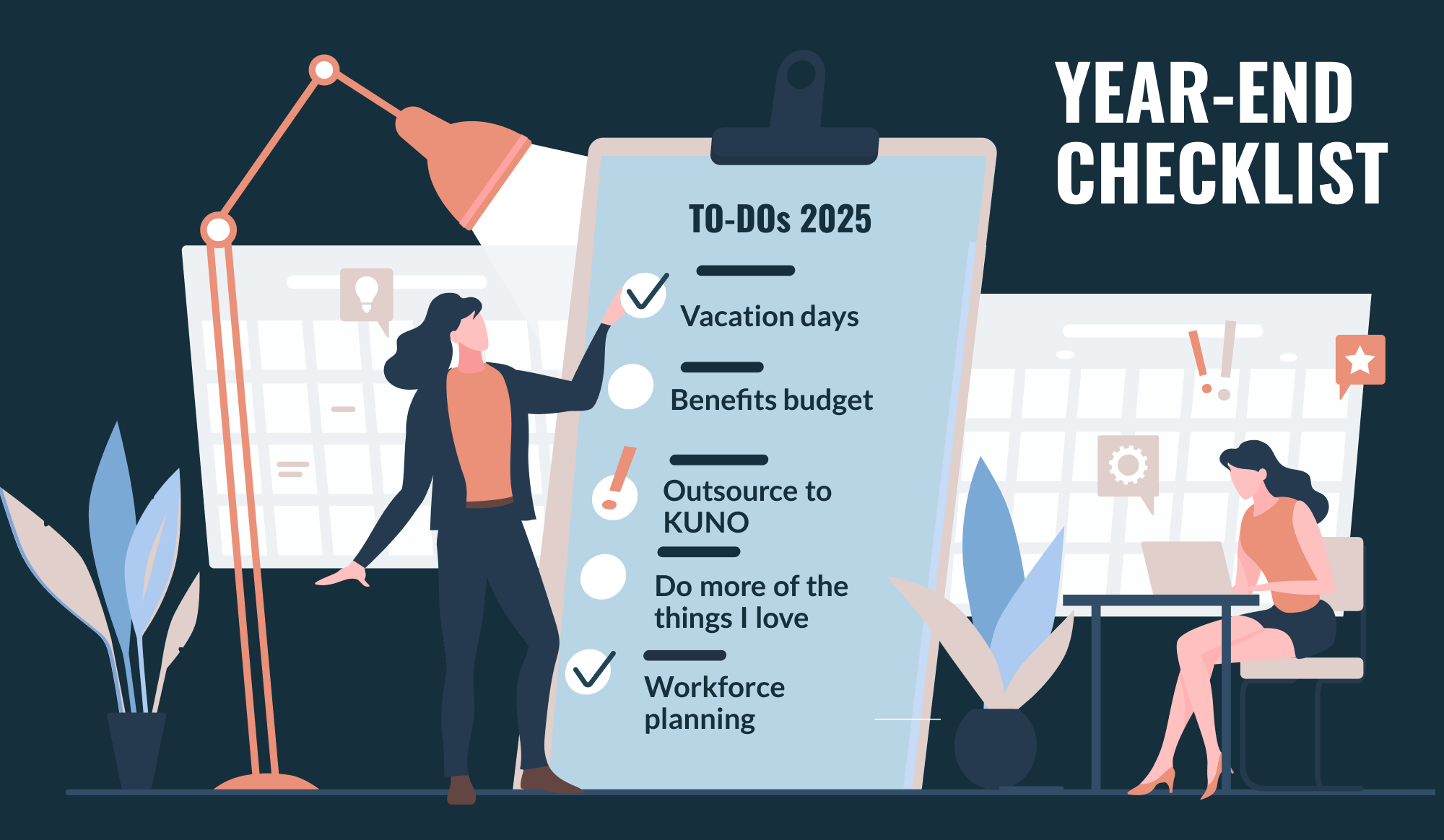
Year-End Sprint in HR & Payroll – What Matters Most for 2025
6. Cleaning Up HR and Payroll Systems
Year-end is the perfect moment to tidy up your systems — not as a theoretical audit, but as a practical clean-up. Over the year, HR Information Management Systems and payroll databases often accumulate incomplete or outdated records.
Now is the time to check:
- Are all relevant employee details complete and up to date?
- Are there information fields or sections rarely used that can be simplified or removed for the new year?
- Should internal structures or data categories be updated to make systems leaner and more efficient?
It’s also worth reviewing data retention and deletion policies: Which personal records must be deleted, and which must be archived for compliance reasons? Regular reviews prevent unnecessary data storage, ensure compliance with data protection laws (e.g., GDPR), and reduce long-term storage and admin costs.
Conclusion: This clean-up creates order, clarity, and data security. It saves time in the coming year and ensures HR and Payroll start 2026 with accurate and reliable data — a small investment with a big impact.

FIND OUT MORE ABOUT KUNO
